

Which Career is right for me? What do I like? What do I want to do? Where do I want to be in ten years?
Questions, questions, questions. Many of you have such questions about careers. Many people after Advanced Levels seem to have no idea what to do for a living.
When I was very young, I was so annoyed by everyone asking what I wanted to be. I told them I wanted to be a racing cyclist—I had just got my lovely, red ladies bike. What did I care, “let them be shocked”, I thought. They were, I think.
Most people just stumble upon their careers. They just get a job and stick to that path. In my opinion, finding a career path should be a carefully thought out decision. So this article is showing you the correct way to go about finding the careers that are right for you.
Note that I said careers, in plural. There may be many career paths that are right for you.
Most people just stumble upon their careers.
~Nilooka Dissanayake
Finding a career path should be a carefully thought out decision.
My experience in finding a career
Take me for example: Aside from the racing cyclist idea, I really didn’t know what I wanted to be when I was doing Ordinary Levels. Towards the end of OLs, I fell in love with a television programme called Daktari, about a team of veterinary surgeons working in Africa. By that time I had also discovered Gerald Durrell, who started the Jersey Wildlife Preservation Trust, now renamed as Durrell Wildlife Conservation Trust. I decided I wanted to be a vet.
I worked at the National Zoological Gardens after OLs. I did bio science for Advanced Levels. I was sure I knew what I wanted to be. My teachers did not like to hear me say I wanted to be a vet, because to them, it seemed like an inferior choice. But for me, for the life of me, I did not want to be a doctor, dealing with people all the time.
Then, universities were closed due to civil strife. And I just applied for Colombo Bio Science and decided I did not want to go to University, thank you very much. My father, Nihal Dissanayake, wanted to know what I wanted to do. At the time he was at the Merchant Bank of Sri Lanka and seemed to be enjoying his work as a Management Consultant immensely. So I said I wanted to be one too. His advice was to do CIMA. And I did.
A lot of people thought it must have been difficult to do accounting after doing bio science. I did not think so at all. And I completed CIMA in two years, the shortest possible time. When university admissions came up, I decided I was not going. I was a professional, and I was going to work…
Then later I quite that post MBA and became a journalist, and then a trainer. So from personal experience I can say people don’t have just one thing that is right for them. Likes, dislikes as well as life situations and circumstances determine our choices along the way.
Finding a Career Path That is Right For You
Finding the right career path for yourself can be a deeply fulfilling journey. To discover which careers align with your interests, skills, values, and lifestyle preferences, I suggest you follow these steps:
Do a Self-Assessment
Start by taking an inventory of your skills, strengths, weaknesses, interests, and values. Reflect on what you enjoy doing in your free time, what tasks come naturally to you, and what values are most important to you in a job (e.g., work-life balance, helping others, creativity).
Consider Your Skills and Talents
Identify your core skills and talents. Consider both hard skills (e.g., programming, writing, accounting) and soft skills (e.g., communication, problem-solving, leadership). What are you naturally good at, and what skills have you acquired through education and experience?
Also Consider Your Interests and Passions
Explore your interests and passions. Think about the subjects or activities that genuinely excite you. What topics do you enjoy reading about or researching in your free time? What hobbies or activities do you find fulfilling?
Pay Attention to Your Values and Priorities
Determine your core values and priorities. What matters most to you in a job? Is it financial stability, making a difference in the world, creativity, or flexibility? Naturally, your values will influence your career choices.
Research Careers—Yes, Plural
Use online resources, career books, and career assessment tools to research different professions. Pay attention to job descriptions, required skills, educational requirements, and salary ranges.
I suggest watching a few YouTube videos for each different career path you want to explore. I get my son to watch “A Day in the Life of…” videos so he gets an idea of various things people do.
Network – Talk to Various Professionals
Talk to professionals in various fields through informational interviews or networking events. Ask about their career paths, day-to-day responsibilities, and the pros and cons of their jobs. Why they chose that career, how they prepared for it and what they dislike about it. This can give you a lot of valuable insights.
Take Career Assessments
Consider taking career assessments or personality tests, such as the Myers-Briggs Type Indicator (MBTI), Strong Interest Inventory, or Gallup StrengthsFinder. These can help identify potential career matches based on your personality and preferences.
While some of these are behind pay walls, there are many free career and skill assessments that are less formal and not as scientific. Try them out as well.
Set Career Goals for Yourself
Establish clear career goals for yourself.
Where do you see yourself in five, ten, or twenty years? Having a vision can help you narrow down your options.
What Education and Training is Needed
Evaluate whether additional education or training is needed to pursue your chosen career path. Some careers require specific degrees or certifications.
Dare to Experiment
Try out internships, part-time jobs, or volunteer opportunities in fields that interest you. Practical experience can provide valuable insights and help you determine if a particular career is the right fit.
Seek Guidance
Talk to career counselors, mentors, or advisors who can provide guidance and support in your career exploration journey. Don’t discount your parents either in this. They may have some insights on certain careers that you cannot see.
Evaluate and Adjust
Be open to adjusting your career path as you learn more about yourself and different professions. It’s okay to change direction if you find that your initial choice isn’t the right fit.
Balance Your Personal and Professional Life
Consider your lifestyle preferences and how your career choice will impact your work-life balance, location of residence, and daily routine.
Finding the right career often involves self-discovery and exploration. You need to be patient with yourself and be open to new possibilities. Your career path may evolve over time as your interests and priorities change, as you grow older.
Remember: A fulfilling career is one that aligns with your passions and values while allowing you to use your skills and talents to make a positive impact. That is called finding the sweet spot.
Want More Info on Finding Careers?
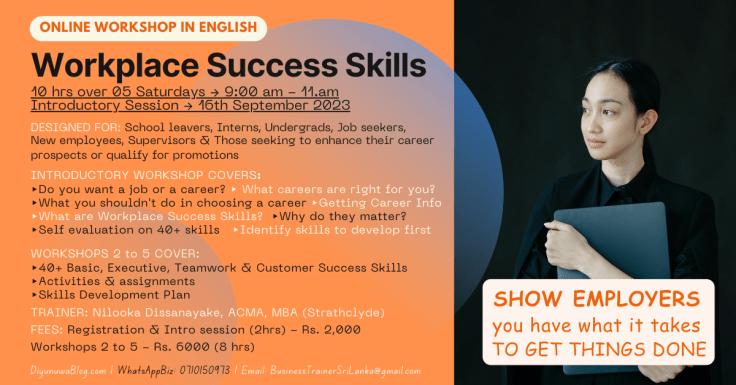
Join the Introductory Session of my Workplace Success Skills online workshop. I discuss the following in that session:
- Do you want a job or a career?
- Do you know what careers are right for you?
- Where can you find more information?
- Things You Should Not Do in Choosing a Career
- What are Workplace Success Skills and why do they matter?
- How good are your Workplace Success Skills? Find out how you fare with a self evaluation questionnaire on 40+ Workplace Success Skills.
- Identify which Workplace Success Skills you need to develop first.
By: Nilooka Dissanayake
 DiyunuwaBlog.com | දියුණුව
Leave a comment